
+49 9571 9400 117 info@pet-interiors.com

Poison bait – a deadly danger for our dogs

The most important rule is:

Even if there is only the slightest suspicion, do not hesitate and take your dog to the vet immediately.
your dog to the vet immediately. Because if your four-legged friend has really swallowed a poisoned bait, this can cause the first signs of poisoning within a very short time.

The first signs of poisoning can be
– vomiting
– excessive panting
– white salivation
– pale mucous membranes
– altered pupils
– listlessness

Unfortunately, the signs are not always immediately noticeable and much depends on the type of poisonous bait.

Rat poison

The disastrous thing about rat poison is that the first signs may only appear after a few days. Typical signs of poisoning with rat poison are vomiting, tiredness, bloody diarrhoea and a low body temperature. 2-3 days after ingestion of the rat poison, bleeding occurs on mucous membranes and from body orifices and the dog usually dies of organ failure within 3-5 days.

Insecticide slug pellets

Insecticide slug pellets are also often used to poison baits. It works much faster than rat poison and the first symptoms of poisoning can occur after just 30 minutes. Please consult a vet as soon as possible. As soon as the poison has entered the bloodstream, the vet can only provide symptomatic treatment. The perfidious thing about slug pellets is their sweet flavour, which is why dogs and cats like to eat them.

Narcotics

As dog haters will use anything they deem useful for their purposes, baits can also be laced with anaesthetics. If your pet has swallowed one of these baits, signs such as loss of consciousness or staggering will occur within a very short time.

Bait spiked with sharp-edged objects.

If your pet has eaten a bait spiked with nails, razor blades or metal spikes, you will often notice blood in your pet’s mouth. In this case, too, you should make your way to the vet as quickly as possible and, if possible, announce the visit on the way.

Do you suspect poisoning?

1. absolutely refrain from self-medicating.
2. call a vet or veterinary clinic immediately and announce the emergency.
3. take your dog for veterinary treatment immediately and without delay.

Do not self-medicate!

You can find lots of first aid tips for poisoning on the Internet, but most of them are hardly practicable and can even be life-threatening. Please do not make your dog vomit under any circumstances, because if he has swallowed sharp-edged or corrosive substances, his condition could worsen considerably.

The administration of activated charcoal may also cost vital time. Charcoal tablets
bind toxins in the body, but the necessary dosage depends on the dog’s body weight.
body weight of the dog.

In an emergency, every second really counts, so contact a vet immediately
vet immediately and give notice so that you can be treated as quickly as possible. Quick and immediate treatment can save your dog’s life.

Please make a note in your telephone:

Address and telephone numbers of neighbouring vets and veterinary clinics.
Even if you are on holiday, this may save your life.

Poison bait also in your private neighbourhood.

Unfortunately, intentional poisoning of dogs and cats also occurs among neighbours. Neighbours may feel disturbed by the barking of dogs. If dog owners allow their four-legged friend to defecate in the neighbour’s driveway or front garden, trouble is inevitable. Unfortunately, the animal perceived as a nuisance is only a poison bait throw over the garden fence away.

How can I prevent my four-legged friend from ingesting poison bait?

More on this in our next blog post: Can I prevent my dog from eating a poison bait?

Which plants are poisonous for my dog? You can find out more here:

Nutrition for large dogs

What should the optimum diet be for large dogs?

Nutrition plays a major role in keeping your pet healthy and lively. Whether small or large dogs and small dogs, food plays a decisive role in your pet’s health. Here you can find out what you should pay attention to so that the diet for large dogs is balanced and healthy and keeps your pet fit and agile.

Here is a selection of large dog breeds:

Bernese Mountain Dog
Saint Bernard
Great Dane
Broholmer
Great Dane
English Mastiff
Irish Wolfhound
Landseer
Leonberger
Kangal
Newfoundland
Pyrenean Mountain Dog
Rottweiler
Scottish Deerhound

The best orthopaedic dog cushions for large dogs that perfectly support the joints and spine can be found at pet-interiors.

Nutrition for large breed puppies.

Adult dogs, whether small or large breeds, need approximately the same nutrients. However, this does not apply to puppies in the growth phase. Large breed puppies have very specific and high nutritional requirements. Large puppies need to gain weight quickly, and their weight increases approximately 100-fold by the time they reach adulthood. In small dog breeds, the difference in weight from birth to adulthood is not so great; they gain about 20 to 30 times as much weight. It is therefore essential to avoid nutritional errors during the growth phase in large dog breeds.

Why do large dogs defecate differently to small dogs?

Large dogs have a proportionally shorter gastrointestinal tract than small dogs, which is why they defecate more often and usually have poorer faecal quality than smaller breeds. Large dogs also release more sodium and water into the large intestine, which increases the water content in their faeces. You can prevent this digestive problem with highly digestible food if you tailor the diet for large dogs perfectly to this.

How should food for large dogs be formulated?

If it is a ready-made food for large dogs from a well-known dog food manufacturer that you trust, the special needs of a large dog should be taken into account. Of course, you can put together the food and treats (you can find the recipe for dog biscuits and dog cookies here) yourself and perfectly customise the diet for large dogs.
Then these easily digestible products should be included: Muscle meat e.g., from beef, pork, sheep, game, plus eggs, dairy products such as quark or cottage cheese, carbohydrates from cooked rice or oatmeal, plus oils or fats. The advantage of homemade dog food is, of course, that you know exactly what is in the food for your large dog. However, it is very important to pay close attention to the composition of the food so that your pet does not suffer any deficiencies.

What are the energy requirements of large dogs?

The energy requirements of large and small dogs are similar. The energy requirement depends more on how active the dog is, the age of the pet and whether it is a long-haired or short-haired dog. Dogs with a thin, short coat with little undercoat need more energy to maintain their body temperature. If the dog has a lot of muscle mass with a low body fat percentage, its energy requirement is also higher.
A very active, agile and lively dog consumes more energy than a calm, comfortable and perhaps older animal. You should definitely take these considerations into account in your diet plan for your large dog.

When do cats get cold?

Our feline companions never leave the house without their fur coats. Thanks to their protective fur, a healthy cat doesn’t get cold nearly as quickly as we humans do.

Outdoor cats have the advantage that their winter coat develops in good time. At the slightest change in outside temperature, their undercoat grows, and before it gets really cold,

they are well protected. Make sure your outdoor cat always has access to a sheltered, warm place so they can warm up when needed.

But when do cats get cold in winter, how can I tell, and how can I protect them from catching a cold?

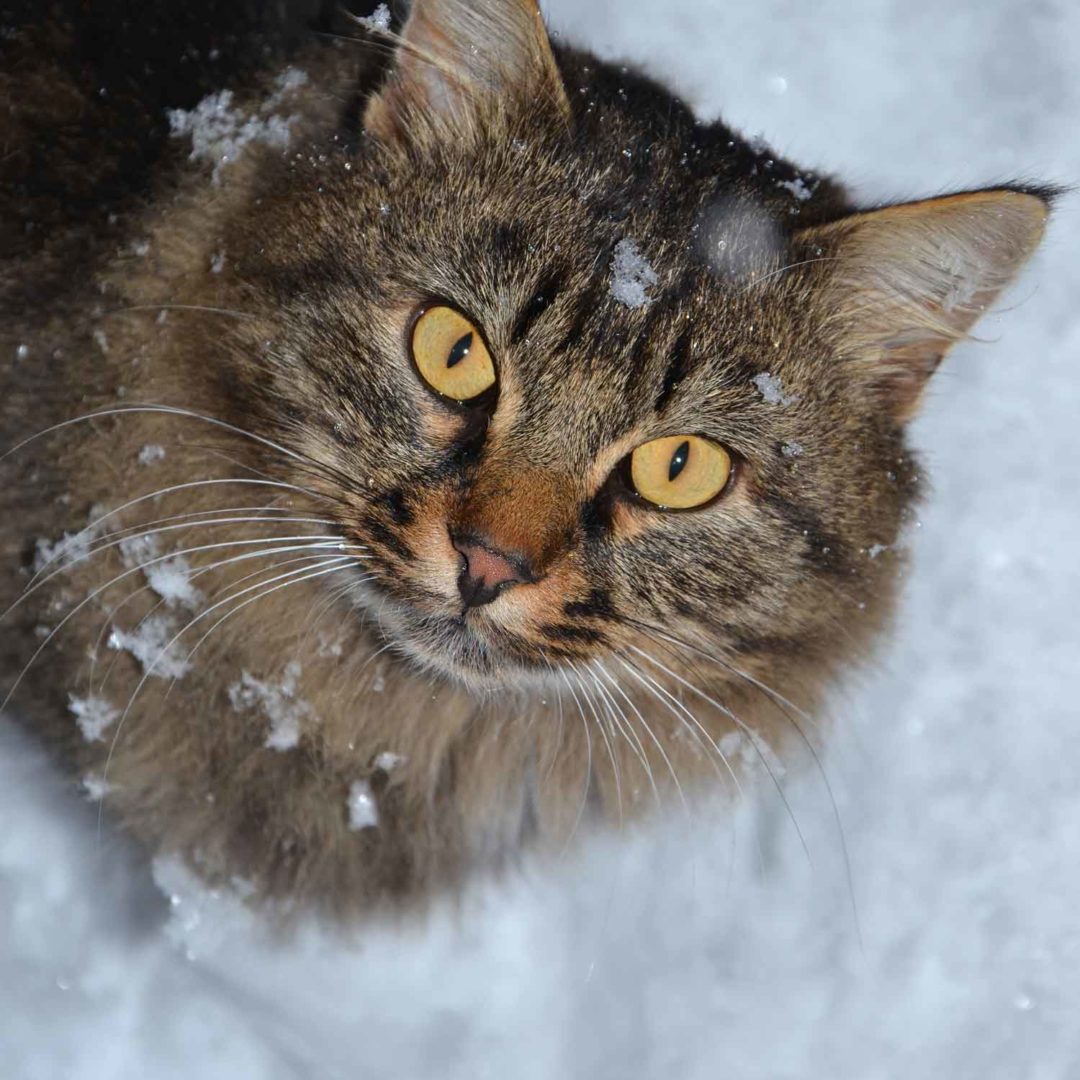
cat in the winter snow

Thanks to their thick undercoat, cats don’t get cold as quickly in winter.

Observe your cat’s posture.

You can tell when cats are cold by their body language. They fluff up their fur so that the resulting layer of air between the hairs provides insulation. By hunching over, they reduce their surface area to offer less resistance to the cold. Their eyes are closed, except for a small slit.

When do cats get cold, and when is it too cold for a cat?

This depends on their general condition and health. A healthy cat can tolerate temperatures as low as -20°C (-4°F). The key to how well a cat tolerates sub-zero temperatures is keeping its fur dry. If your feline friend gets wet and is also exposed to a draft, even slightly below-freezing temperatures can be dangerous. A cold is nothing to take lightly, and hypothermia can be fatal.

Should my outdoor cat stay indoors during the winter?

This is something to consider for sick or elderly cats. But a healthy cat accustomed to being outdoors will be too distressed if it is no longer allowed to do so. It is important, however, to ensure that outdoor cats always have access to a warm retreat.

A Warm Retreat Outdoors

If your cat doesn’t have the option of retreating to the warmth of your home at any time, it’s advisable to provide a warm retreat outside. A doghouse lined with straw and polystyrene makes a good retreat.

We offer cat houses made of 100% pure wool felt, which naturally provides excellent insulation. With their cozy latex cushions, they also offer good protection from the cold underneath. These retreats keep cats warm outdoors, even in sub-zero temperatures.

Do Cats Get Cold Indoors in Winter?

Older indoor cats can already feel the cold when we humans don’t even perceive it as particularly cold. Provide your feline friend with a sheltered, cozy retreat indoors. This reduces heating costs and will delight your feline friend.

Activities for outdoor cats in winter

To prevent your outdoor cat from getting bored indoors, it helps to spend plenty of time with them. Long petting and cuddling sessions on the sofa and intensive play sessions help to compensate for the lack of exciting adventures in nature. Here you’ll find great cat toys made of felt.


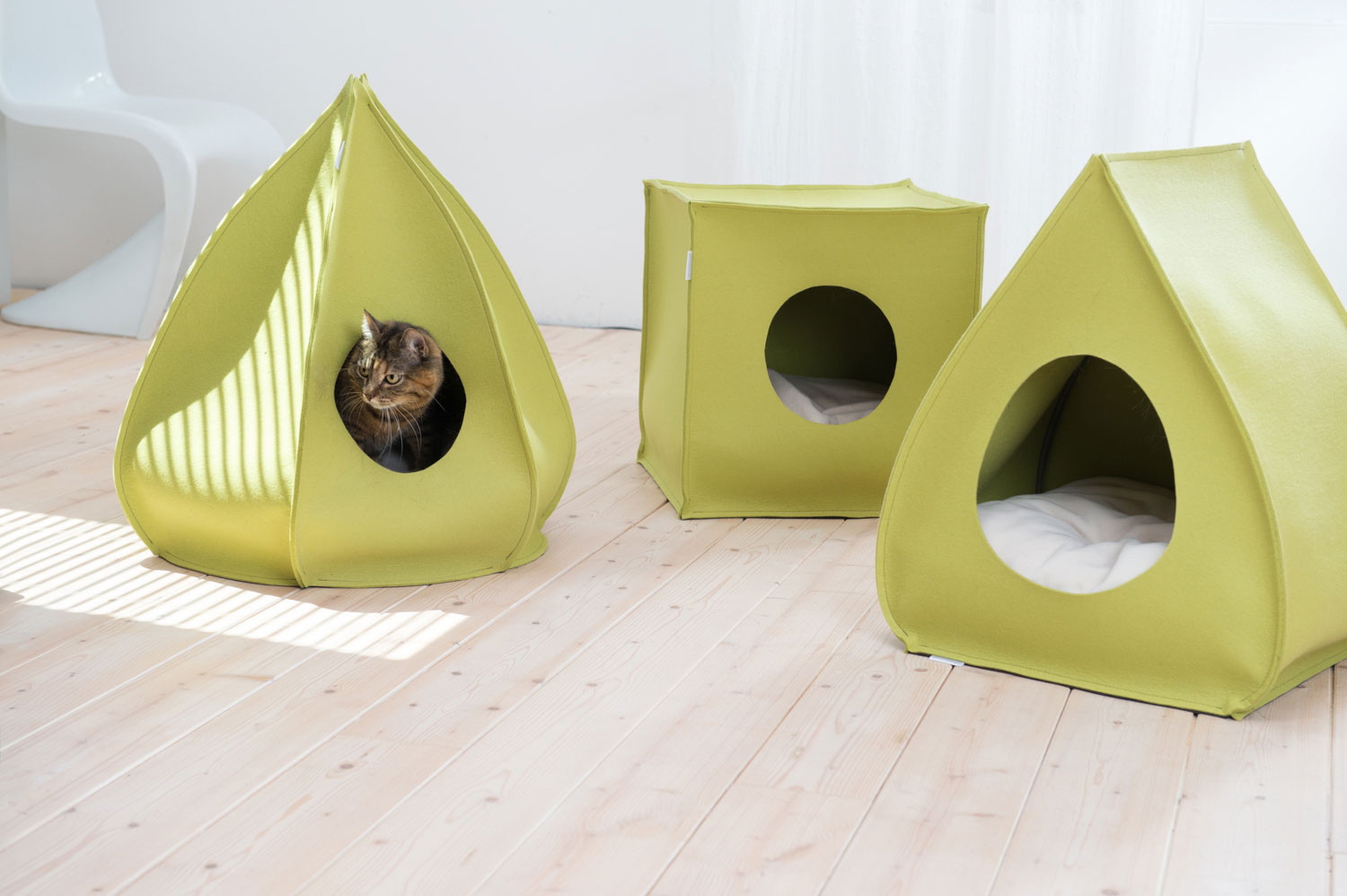
Tabby kitten in the Berta felt cat house from pet-interiors

A felt cat house is ideal as a warm retreat for outdoor cats.

Beauceron dog breed

Beauceron dog breed

The Beauceron is a very original, powerful, robust and muscular dog, but without any sluggishness. It impresses with its stamina and incorruptibility.

Why is my cat unclean?

Why is my cat unclean?

Is your cat messy and no longer using the litter tray? This behaviour can have various causes and in this article we give you useful tips. The first port of call should definitely be the vet, …

What is the best cat litter?

What is the best cat litter?

The choice of cat litter is huge. Mineral cat litter, silica litter, litter made from plant fibres, fine or coarse-grained, with or without fragrance, …